
Lessons From The Welcome Table
Or how privileged people must stop being angry when marginalized people feel and share joy, too

A reader named Kim Beckett informed me today that I write nothing revolutionary anymore, that all she sees is a woman posting pictures of food. She meant it as an indictment. I want to thank her for it, because she has handed me the exact subject I have been circling for three months.
James Baldwin left the United States because it was killing him. Medgar Evers, Malcolm X, Martin Luther King — his friends, murdered one after the other, until the grief closed his throat and he could no longer write. He went to a small village in the south of France called Saint-Paul-de-Vence. People who misunderstood him called it desertion. He called it survival, and out of that exile he produced some of the most unsparing pages ever written about America.
Here is what he built there, in the hills above the Mediterranean, while the country he loved and flayed carried on without him: a table.
Friends gathered around it late into the night. He fed them. When a young writer he'd befriended came to him stung by a rejected fellowship, Baldwin's reply carried no lecture about the struggle — he told the man he had no fellowship to offer, but if he made it down south, there'd be a pork chop waiting. He was offering the thing the fight is actually for.
His final work, unfinished when cancer took him in 1987, was a play. He called it *The Welcome Table*. The title comes from the old spiritual — *I'm gonna sit at the welcome table one of these days* — where the welcome table is the seat the faithful reach at the end of everything, the place no one can deny them. Henry Louis Gates, who sat at Baldwin's real table as a young journalist, called it a metaphor from the Black sacred tradition: the place the good go when they die.
Consider what that means, coming from him. The man who wrote the fire and the rage of the century chose, for his last testament, to write a dinner party. Hospitality. Rest. Community. Exiles gathering to set their burdens down. One friend described the real table as a place of witness, somewhere the displaced could finally lay their souls.
So when I am told that food is not revolutionary, I understand that the person telling me this has mistaken the weapon for the war.
The people who need me miserable in order to believe I am serious have swallowed the oldest lie the powerful ever told: that the oppressed prove their worth through suffering, that a woman in a fight forfeits her claim to a good meal and good light and a dog asleep in the sun. Misery is the condition they want to keep us in. My joy in Spain is not a retreat from the American emergency. It is evidence. It is the photograph of what we are fighting to be allowed — a life. A table. Food we did not have to run for.
I have filed radical reporting every week for three months, while homeless, while crossing three countries, while running from the very forces I name. And yes, between the exposés, I have shown you my lunch.
Baldwin ran, too. Then he set a table and called the world to it. I am setting mine. The invitation stands for everyone — even Kim Beckett, especially Kim Beckett. Pull up a chair.
You are not running. You are repositioning your movement for the final battle. Stay safe and wise.
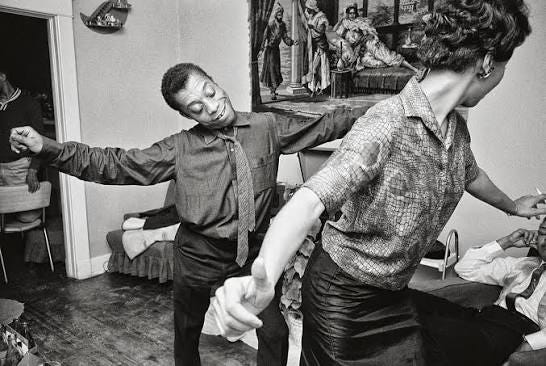
I read this essay, but I didn’t even have to read this essay. James Baldwin and Lorraine Hansberry dancing together is a fond memory. When she died prematurely from cancer, I remembered Jimmy calling her “Sweet Lorraine” and recollecting when she and he got nice and drunk and he staggered down the stairs from her apartment in the early morning after having debated about everything. I love my people like this, unencumbered from having to deal with white folks. Just us having the good times that white folks will never be invited to.