

This article isn’t just about Mexico. It’s about what’s still possible everywhere.
If you believe in people-powered change — in feminist leadership, social justice, and a future that centers care — subscribe now to support this kind of analysis from a place of hope and fire.
Every September 15, the President of Mexico steps onto a balcony overlooking the Zócalo — the vast central plaza in Mexico City, once the ceremonial heart of the Aztec empire — and calls a nation to remember who it is. Below, a sea of people wave flags, sing, cheer, and wait for the moment when the bell rings and the President cries out the words that launched a revolution.
The ritual is called El Grito de Independencia — The Cry of Independence — a reenactment of the moment in 1810 when Father Miguel Hidalgo rang the church bell in Dolores and called for revolt against Spanish rule. Over two centuries later, the president still rings that same bell. Still cries out: ¡Viva México! And the people roar in response.
But this year, something changed.
Because this year, the president was a woman.
A New Voice in a Sacred Place
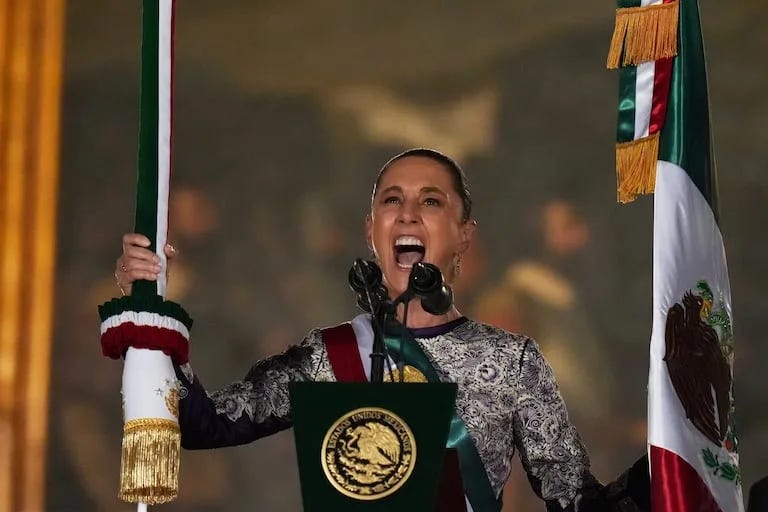
Claudia Sheinbaum made history when she became Mexico’s first woman president — and the first of Jewish heritage. But on the night of September 15, she made history again. Standing on the Palacio Nacional balcony, clad in white, royal purple and gold, flanked by an all-female military honor guard and wearing a sash created for her by female military officers, she gripped the bell rope and, as required of the ritual, shouted. Normally soft-spoken and measured, the tone was a shift for the climate scientist, who visibly trembled under the weight of the task, but not as big a shift as what she shouted:
“¡Mexicanas! ¡Mexicanos!”
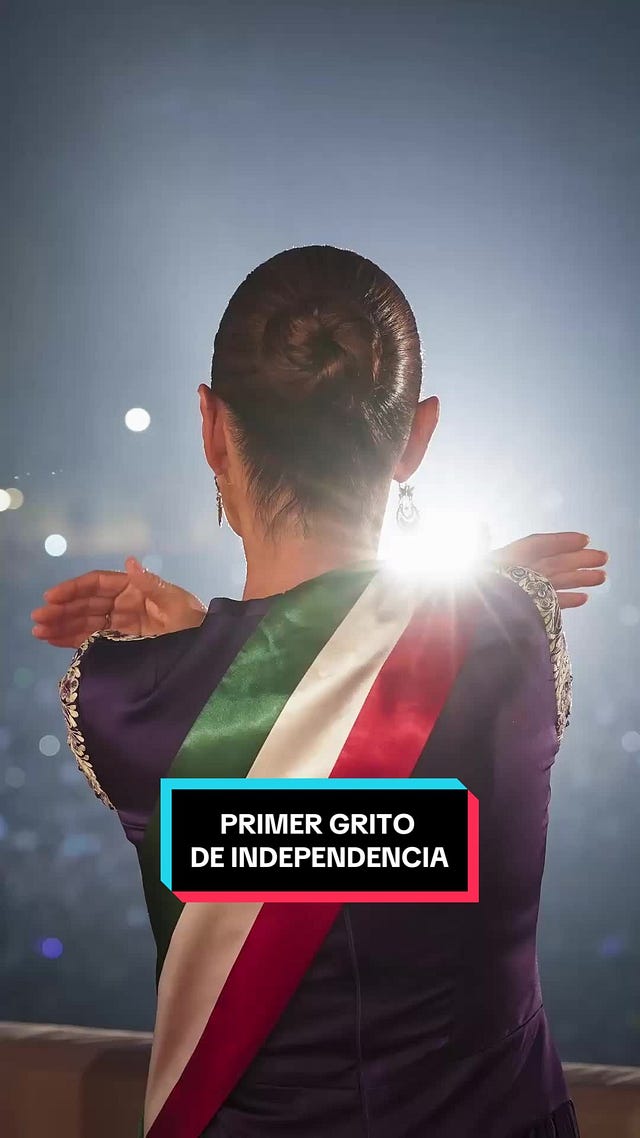
 Tiktok failed to load.
Enable 3rd party cookies or use another browser
The inclusion of the feminine “Mexicanas,” and naming them FIRST matters. For over 200 years, presidents have addressed the nation with “Mexicanos” — masculine plural, everyone in theory, but not always in practice. By naming women first, Sheinbaum didn’t just rewrite a sentence. She reclaimed the soul of the nation for the people most often left out of it. Across Mexico and among the Mexican diaspora in the United States and elsewhere, women felt it in their souls.
And then Sheinbaum kept going.
She invoked not just the heroes of 1810, but added new heroes to the traditional list: indigenous women, equality, freedom, and sovereignty. She didn’t just perform the ritual. She expanded it. She included not just the usual names of male revolutionary heroes, but also those of the women who fought for Mexican Independence.
And the people responded.
More than 280,000 of them — a crowd equivalent in size the entire population of St. Louis, Buffalo, or Orlando — filled the massive Zócalo and its surrounding streets, waving flags, cheering, answering her cry, witnessing a woman ring the bell of revolution and make it hers.
No.
Making it ours.
Love this kind of reporting? Alisa Writes is reader-powered. If you value deep, principled writing that celebrates global progress while challenging U.S. political stagnation, consider becoming a paid subscriber. This space is for truth-telling, not doom-scrolling.
Not Just Optics. Outcomes.
While the President and Vice President of the United States, and the the conservative media that does their bidding, use the murder of Charlie Kirk to fan the flames of violence and division in our country, Claudia Sheinbaum is using her position to bring her people together across the political spectrum, with bold new social and economic initiatives designed to improve life for the poorest Mexicans. This is the opposite of the trickle-down economics embraced in the USA by both major political parties — and it’s working.
Since taking office nearly a year ago, Claudia Sheinbaum has quietly led one of the most transformative presidencies in Mexican history — particularly for women, Indigenous communities, and the working class. She created the Pensión Mujeres Bienestar, a groundbreaking national pension for women aged 60–64, prioritizing rural and Indigenous recipients long excluded from social safety nets. Her administration has expanded welfare programs that now support over 30 million people, contributed to a 25% drop in homicide rates, and overseen a historic poverty reduction. She’s built or opened 15 new hospitals with 16 more in development, launched mobile health services through Salud Casa por Casa, and constructed over 38,000 new high school classrooms, while opening new campuses of the Rosario Castellanos University. She’s also rolled out a national initiative to harmonize the high school diploma across all 32 states — a major step in educational equity.
For women and girls especially, Sheinbaum’s first year has marked a cultural and material shift. She signed landmark agreements to expand the National Care System, re-launched publicly funded childcare and early education centers (CECI), and partnered with the IMSS to distribute Women’s Rights Booklets across the country. Her climate and sovereignty agenda is equally bold: she co-signed a tri-national pact with Guatemala and Belize to protect the second-largest rainforest on Earth; invested in renewable energy infrastructure; and announced the launch of Olinia, Mexico’s first domestically produced electric mini-car, aiming to create green jobs and reduce reliance on foreign automakers. Across every sector — healthcare, education, safety, environment — Sheinbaum is not tinkering at the edges. She is rebuilding the foundation of the state to serve those who’ve been ignored for too long.
This is not trickle-down rhetoric or market-first maneuvering. This is what it looks like when the state remembers its duty to its people, regardless of their politics. Especially its women. Especially its poor. Especially those pushed to the margins for too long.
Mexico — glorious, complicated, beloved Mexico — is showing its neighbor to the north something else, too: What if it’s not too late to build something beautiful? What if democracy is not just something to mourn, but something to remake? What if progress isn't always incremental and fragile — but sometimes explosive and undeniable?
A Blueprint for Us to Follow
Claudia Sheinbaum’s rise wasn’t a fluke. It was the result of decades of movement-building — from the Zapatistas to the feministas to the grassroots organizers who knocked doors, built coalitions, demanded better. It was the result of a nation that tired of neoliberal economics and its broken promises, and turned toward something bolder, riskier, and rooted in solidarity.
I believe we can do that here, too. We can build coalitions across race, class, gender, and region. We can support women and queer leaders. We can fight for health, housing, food, and dignity — not as luxury items, but as rights.
We can make room for new voices, new orders, new cries of freedom. Most of all, we can learn to love one another despite our differences, to build our society through kindness, compassion and tolerance for people who are not exactly like us.
But first, we have to remember that it’s possible.
Sheinbaum reminded her people yesterday.
Maybe her voice can remind us, too.
Viva la presidenta! Claudia Sheinbaum is my shero, what an intelligent, strong, brave leader. And what a contrast to the US and its weak, cowardly, senile, stupid, and corrupt president and politicians.
Very moving to see a female in power. I don’t care what others may say. Mexico is truly moving forward and I am happy to see the tides shifting for them. Happy Independence Day Mexico 🇲🇽💕