

I offer my news, investigations and analysis for free, but your support is necessary and appreciated. Please like, comment, share and subscribe, paid if you can. You may also leave a one-time or recurring tip in any amount. Just four $25 tips per day keep me writing full-time. Thanks!
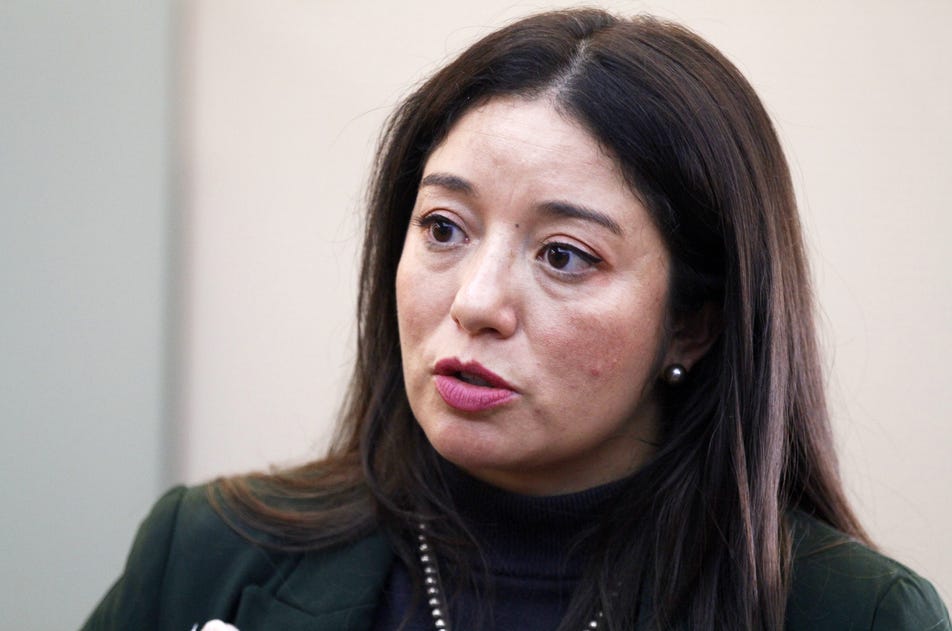
Andrea Romero has a talent for finding public money and a habit of not being able to explain how she ended up holding it.
The Santa Fe Democrat — state representative, chair of the New Mexico Truth Commission supposedly investigating Jeffrey Epstein’s Zorro Ranch, and, as of this week, the subject of a Republican demand for a criminal investigation — has quietly been drawing a second government paycheck since May. Since then, while sitting in the Legislature and steering a $2 million taxpayer-funded probe that hired a law firm whose partners had repeatedly donated to her own campaigns, Romero has also been on the payroll of the First Judicial District Attorney’s Office, a fact that, in the words of Santa Fe New Mexican reporter Phaedra Haywood, “appears not to have been widely known prior to this week.”
There is a reason it wasn’t advertised. The state’s own lawyers say she isn’t allowed to have the job at all.
The job the state says she can’t hold
The New Mexico Department of Justice could not have been clearer. Its chief of staff, Lauren Rodriguez, told the New Mexican that the office had advised both the Legislature and the DA’s office in late 2025 that sitting legislators are prohibited from working as assistant district attorneys. State law, she said, “bars any legislator from receiving compensation as a state employee and bars any state officer from compensating a legislator for their services.” As for Romero’s arrangement: “no such exemption exists for legislators serving as either full-time or part-time employees of a district attorney’s office.”
Romero says she got a green light. She told the New Mexican she asked Attorney General Raúl Torrez’s office whether she could take the job and interpreted the response as approval — then pasted a block of text into an email to the paper that, conveniently, carried no date and no signature. That text leaned on AG Opinion 2024-04, the opinion Torrez issued in the matter of Rep. Andrea Reeb’s stint as special prosecutor in the Alec Baldwin Rust case. But that opinion turned on a narrow point: a special prosecutor’s power is “only temporary or occasional.” It did not bless a legislator taking a standing, salaried job in a DA’s office. The DOJ says so directly.
So we are left with two branches of state government describing the same job in incompatible terms — and a legislator who would like us to believe the confusion is everyone’s fault but hers.
Please bear in mind, too, that Romero was named by other members of the commission as the person who quietly erased all mention of the current Democratic gubernatorial candidate, Deb Haaland, from any mention in the Truth Commission’s first report, released earlier this month. Haaland is named in the Epstein Files as a passenger on a private plane chartered by Epstein at the request of former New Mexico Attorney General Gary King, then running for governor, with Haaland, then, running for lieutenant governor. Epstein bought Zorro Ranch from King’s family and never investigated Epstein during his two terms as the state’s attorney general.
What, exactly, is the job Romero took?
Here the story gets slippery in a way that should be familiar to anyone who has followed Romero’s career.
District Attorney Mary Carmack-Altwies’s May 12 offer letter hired Romero as an “Assistant District Attorney” — precisely the title a legislator is barred from holding under the 2024 opinion. The same letter conceded the problem in advance, making the offer “contingent upon ... [an] ethics check due to your position as a State Representative in the New Mexico legislature.”
By this week, the office’s story had changed. A DA spokesperson now says Romero is an “Assistant Trial Attorney in a non-court facing role” who “does not sign pleadings or represent the state in court.” Except the public job posting for that very position states the opposite: “This position represents the State of New Mexico in criminal proceedings.” Asked to reconcile the offer letter, the posting, and the new description — and to say whether a unique position had been created for Romero — the office did not answer.
Then there is the money. The state Sunshine Portal lists Romero’s salary at roughly $94,000 a year; she says that figure would apply only if the role were full-time. At the $48-an-hour rate the office quotes, a full-time schedule works out to about $99,000 — more than the roughly $94,000 paid to other assistant trial attorneys in the office, some with more experience than Romero, who finished law school in 2022 and whose own account of her legal background is limited to part-time work at a civil firm. Her résumé before the law, as her campaign site tells it, runs to international development work in Mozambique and ostrich farming.
A newly minted attorney, paid at the top of the scale, in a job the state says she legally cannot hold, at an office whose budget she can vote on. Romero’s summary: “I think it’s pretty straightforward. It’s a part-time job.”
The conflict she keeps not seeing
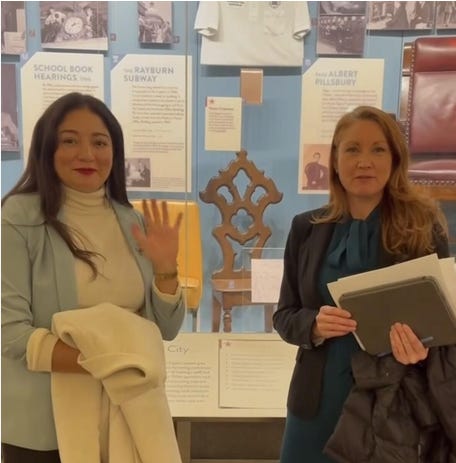
Strip away the title dispute and two conflicts remain, and neither is technical.
The first is separation of powers — the constitutional boundary between the branches that keeps a lawmaker from also drawing a check from the prosecutorial arm of the executive. The second is more basic: Romero, as a legislator, helps set the budget of the very office now signing her paychecks. That is the definition of a conflict of interest, and no green light, real or imagined, makes it disappear.
House Republican Whip Alan Martinez has asked Torrez to investigate whether Romero broke the law by taking the job, and to examine Carmack-Altwies’s role in “authorizing or facilitating Romero’s employment and compensation.” “This is not a technical ethics question that can be brushed aside,” Martinez said. “If these laws were violated, New Mexicans deserve answers and accountability.”
He’s right that it can’t be brushed aside. The question is whether anyone with the power to act will decline to.
A pattern, not an incident
None of this is new territory for Romero, which is the part her “part-time job” shrug is designed to make you forget.
Before she was ever elected, Romero ran the Regional Coalition of LANL (Los Alamos National Laboratories) Communities, a publicly funded agency drawing roughly $200,000 a year. In 2018 the New Mexico State Auditor released a special audit finding more than $51,500 in improper expenditure payments, including $26,862 paid to her own firm, Andrea Romero Consulting. The improper spending included expensive wine and liquor and Major League Baseball tickets — a $1,850 Washington, D.C., dinner reimbursed in full despite a coalition travel policy that flatly prohibited alcohol; $307 for a dozen ballgame tickets. A second, independent audit found after-the-fact accounting changes made to “correct deficiencies.” A nonprofit asked the attorney general to open a criminal investigation. Years later, the coalition was still trying to claw back roughly $8,000 from her; as of mid-2025 it remained unpaid, with the board signaling it would rather move on than keep chasing her. Romero’s defense then was the same as now: she’d followed the process, relied on others to catch problems, and the whole thing was politically motivated. It should be noted that her position was sold to the public as being a voice for the communities around the Los Alamos nuclear weapons laboratories who were concerned about groundwater contamination and other issues, but in reality was a lobbying job in which Romero helped secure large federal contracts for the labs in question. The same labs also gave her a college scholarship fresh out of high school.
And her current perch carries its own unresolved questions — ones THE PUGILIST has documented at length. As chair of the Epstein Truth Commission, Romero voted to hand a $750,000 contract to Fadduol, Cluff, Hardy & Conaway, a personal-injury firm whose orbit had funneled campaign money her way: the New Mexico Trial Lawyers Association’s PAC gave her $1,000 the month before her 2024 election, and the firm’s founders had earlier maxed out to her and donated to figures named in the Epstein files. She has declined to engage with that reporting, dismissing it to a constituent as “blog posts” too “filled with inaccuracies” to be worth the commission’s resources — without ever naming one.
That is the throughline. Every time Romero is caught standing where public money and public power intersect in ways she can’t cleanly justify, the answer is the same: it’s straightforward, it’s routine, someone else approved it, and her critics are playing politics. The audits, the offer letters, the job postings, the donation records and the state’s own legal opinions keep saying otherwise. But blame shifting is her superpower.
She asked, this spring, why she wanted a job in the justice system. She said she wanted to understand “how the system works and what it is we can do to improve it.”
If there were actually any justice in New Mexico’s legal system, she’d be finding out herself by now.
THE PUGILIST has requested comment from Rep. Romero, the First Judicial District Attorney’s Office, and the Attorney General’s office. No one responded.
To be clear, THE PUGILIST is non-partisan, and its owner, editor and head writer is a progressive democratic socialist, not a republican. The publication strives to hold power accountable for corruption, regardless of political party.
The corruption in the American system is astounding.
I’m so glad you got out so you could continue reporting as a true journalist! It doesn’t matter which side of the aisle one sits. Exposing corruption is the only way out of this! Thank you for your clarity and for shining the light in the corners where we seldom look.